Liverpool residential property case study
If you’re a keen nature-lover like our client Janet, read on the learn how Japanese knotweed harms other species.

Bamboo can vary significantly in appearance depending on species, but identifying which type you have growing in your garden or on commercial land is important. In the UK, the key distinction is whether you have running bamboo or clumping bamboo. Running varieties spread aggressively underground, while clumping varieties grow in tighter formations. Below is a practical guide to help you identify bamboo on your land.
Bamboo spreads through underground rhizomes. The growth pattern determines whether the plant runs or clumps.
Running bamboo (monopodial):
If new growth is appearing some distance away from the original plant, it is likely a running variety.
Before examining individual species, check the following:
Although over 1,200 species exist worldwide, only a small number are commonly found in UK gardens.
When identifying bamboo, focus on:
With striking dark canes, the stems often start off green and age to a glossy ebony-black colour as they mature. It can reach about 4 m tall or more and can spread several metres from its parent plant.
The leaves are green and narrow, shaped a bit like the classic bamboo look, and typically grow up to around 12 cm long.
Compared with some straighter bamboos, black bamboo canes may arch or bow slightly rather than standing perfectly upright, giving it a graceful overall form.


Often thought of as the “classic” bamboo, Fish-pole bamboo has upright beige-gold canes and narrow, pointed green leaves (around 15–20 cm long). Young stems are green before maturing to golden.
It can reach up to 5 m in height and, as a running variety, may spread more than 3 m from the parent plant.
A key identification feature is the compressed, knotted nodes at the base of the canes.

Yellow-grooved bamboo is a tall running variety that can reach 4.5 m or more and spread up to 8 m.
It’s identified by its mustard-yellow canes (distinct from the greener tones of golden bamboo) and slender, pointed leaves up to 17 cm long.
Look for the zig-zag growth at the base of the stems — and in sunny spots, the canes may develop a reddish hue.

You can recognise you’ve got Moso bamboo in two ways. First, it’s one of the only bamboos that’s shaped like a tree. Secondly, it has some of the widest canes of any bamboo in the UK, at around 29 cm. It can spread up to around 8 m from the parent plant and, under the right conditions, has the potential to shoot up really quickly. The canes are robust with an apple-green colour when young, fading to a pale yellow as they mature. Unlike many other varieties, the grooves on the stems alternate sides between the nodes. Each node normally throws up two leafy branches, but the leaves are shorter than on most other garden bamboos at about 10 cm long.

Broad-leaved bamboo is easy to identify because its canes and leaves are distinctive. It’s a smaller running bamboo, usually reaching around 3 m high at maturity and able to spread up to 5 m from its parent plant.
The canes form a thicket of dense, upright stems, each usually about 1 cm in diameter, and the stems are often speckled with purple.
The leaves are broad and can reach about 40 cm long, dark green with a yellow line down the middle. In winter, the tips and edges often turn brown.

Arrow bamboo typically grows up to about 6 m tall and can spread around 3.5 m or more from the parent plant. It often forms sizeable thickets of olive-green canes that give it a dense, structural look.
The leaves are usually a solid green colour and can reach around 25 cm long, and sometimes they have yellow stripes along their length, with pointed, arrow-like shaped leaves. Though rare, arrow bamboo can produce flowers in the form of spikelets.

Height: 1.5 - 2.5 m
Hairy bamboo is a small but incredibly invasive running bamboo, known for its fast growth. It’s often the type that specialists are called in to eradicate. It can colonise an area with alarming speed.
The canes are slender and stand upright rather than bending, and they’re a striking green colour with branches.
The leaves are the most distinctive feature: they’re toothed (with little indents along the edges) and have a prominent yellow line down the middle. The leaves can reach up to around 20 cm long, are sword-shaped, and in winter their tips will brown.


Different bamboo species grow in different ways. Identifying whether your bamboo is running or clumping helps you understand how it may behave over time, particularly near boundaries.
If you are uncertain, send clear photographs of:
Find out more about our Bamboo Removal Services.

Howard Downer, AKA Dr. Knotweed, has over 20 years of experience as an Environmental Consultant and is regarded by his peers as one of the most knowledgeable people in the Japanese knotweed industry.
Follow Dr. Knotweed to hear about the latest developments regarding Japanese knotweed and the implications of infestation.
If you’re a keen nature-lover like our client Janet, read on the learn how Japanese knotweed harms other species.

Mortgage lenders are reluctant to invest in land and property compromised by Japanese knotweed.
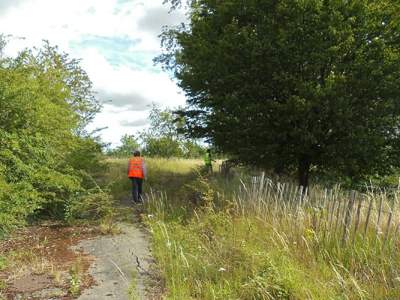
TCM had a lot to get done in a single week. The blessing was that no Japanese knotweed was found on the development site!

St Albans in Hertfordshire is a Japanese knotweed hotspot, so TCM were called to the development site to eradicate the plant once and for all.


