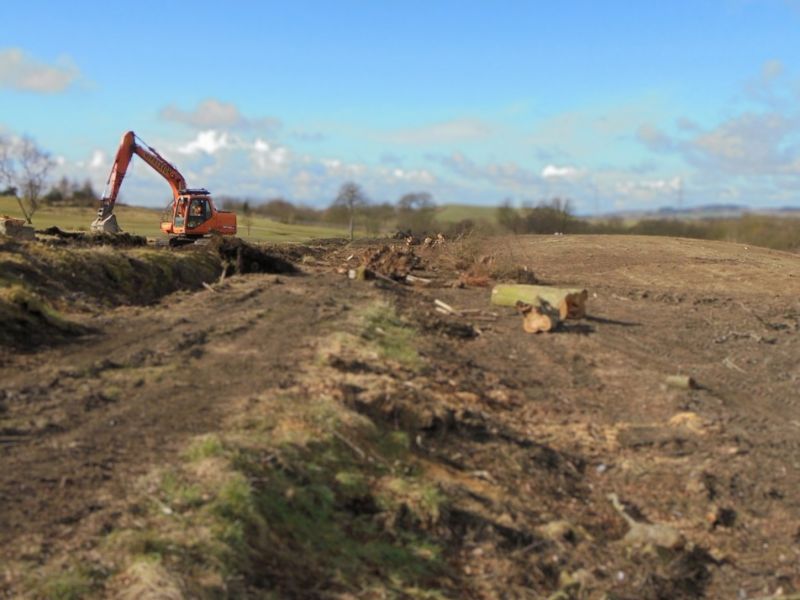
Vegetation clearance on a construction site is a fairly simple process. A team of operatives come to your site, remove the vegetation and leave with the waste.
However, if you’re new to the industry (welcome!) here are the three typical stages of vegetation clearance in more detail.
Stage 1: Survey
Vegetation clearance begins with one thing: the survey! During the survey, a contractor will come to your site to identify what needs to be removed. Do trees grow there, for instance? And what about hazardous weeds? The team will then use this information to determine which vegetation removal methods are most effective for you site. The surveyor will have other questions too. For example:
- Ecology – What wildlife and/or endangered species live here?
- Hazards – Especially for brownfield sites, what chemicals or contaminants will need to be (safely) removed?
- Hidden infrastructure – Are there existing sewage pipes or cabling to be considered before the ground is excavated?
Once the survey is done, your vegetation clearance company should produce a report or document detailing their findings, including a breakdown of what tasks need to be completed as well as the final and total cost.
These surveys may seem a bit pointless, but they are actually very helpful. You will know ahead of time the cost of the works and you are far less likely to be hit with unexpected costs during removal. Not something any novice, or indeed expert, developer wants!
Vegetation clearance

Ecological surveyors often use overnight cameras to identify wildlife

Badgers are protected by law and must be considered before work begins.
Stage 2: Vegetation clearance
The second stage in vegetation clearance is ... vegetation clearance. Just what is says on the tin, mostly.
However, there is a bit more to this stage than you might think. Vegetation clearance is an umbrella term that covers everything from oak tree felling to Japanese knotweed herbicidal treatment and different types of vegetation require different types of removal.
Here are some typical methods.
Excavation
Otherwise known as “digging” excavation is the standard way to remove vegetation from a site. As the fastest method, it’s also the most popular with developers on a tight schedule.
Put simply, the removal operatives will arrive with an excavator (i.e. a digger) to scrape, scoop and deposit. The waste is normally put in a waste carrier or skip and taken off site, creating a blank canvas!
Herbicide spraying and invasive weeds

Herbicidal spraying is sometimes the best option

Beware! Hemlock - invasive weeds
Herbicide spraying
Spraying invasive weeds with herbicides (a glyphosate-based composite) is another method to ensure problematic species don’t grow back. In some circumstances, it’s used on other types of vegetation, depending on the requirements of the site and ecological factors.
In order to be effective, spraying usually takes place over two to three years, so it’s not a popular choice for developers who are pushed for time or simply want to get a move on! However, for sites where only a small stand of invasive weeds grow in a localised area, herbicide spraying is usually the cheapest option.
Tree felling
Tree felling has two main methods: manual tree felling and mechanical tree felling. In recent years, mostly for speed, safety and efficiency, mechanical tree felling has been favoured by most vegetation clearance companies.
For mechanical tree felling, operatives will use an excavator with a hydraulic shear attachment. The design is smart and simple! One part of the machine cuts the tree and the other part holds the trunk steady!
So, what about manual tree felling? Well, to start, the operative will assess the area to ensure it’s safe to fell the tree and try to predict where it will land. Then the chainsaw comes out. Although manual tree felling is still required in some circumstances, it’s clear to see why mechanical tree felling is the preferred option.
Stumps, roots and all

Stumps to be removed to make way for haul road

Digger gathering soil and plant roots
Stump removal
Removing stumps from your site is necessary if you want the the ground level, clear and ready for construction. As with tree felling, there are two ways to handle stump removal: grinding or excavating.
Stump grinding sees an operative using a professional machine to grind the stump and roots to surface level; extraction involves removing stumps manually with tools and elbow grease.
Mulching
Mulching is another type of site clearance. This method sees a “mulcher” machine break up plants on-the-go. Anything from dandelions to saplings are chopped and ground to pieces in the machine. The mulcher then deposits the chips back onto the soil. Mulching has advantages and disadvantages.
One advantage is that mulching is faster and often cheaper than excavating or tree felling. After all, if the mulch chips stay on site then there’s no need to dispose of the waste; plus, it’s kinder to the environment! Never a bad thing.
However, a disadvantage to mulching is that it can’t be used in conjunction with invasive plant species like Japanese knotweed or running bamboo. This is because many problematic plants will continue to spread when their fragments find new ground. They are infamously difficult to get rid of and as no developer wants invasive weeds blooming on their sites mulching would not be advisable!
Crown lifting
Crown lifting is another commonly used vegetation clearance service. With crown lifting, the goal is to remove much of the undergrowth of a tree’s crown, AKA, the bushy bit on top.
Not all vegetation on a development site needs to go. In fact, due to their safe distance from buildings, as well as ecological factors, many trees are simple cut back allowing more light and space to enter the site. We don’t need to tell you trees look nice to prospective buyers!
For crown lifting, professional tree surgeons will come to your site and use a variety of methods to remove the underbelly of the crowns.
Surveys and Strimming

Vegetation clearance starts with a survey

Sometimes a strimmer is the best option for non-invasive vegetation
Stage 3: Removal
The final stage is removing the waste from site. Most vegetation specialists will do this as part of the removal service, but it’s worth checking because developers can be left with a heap of green stuff and not know what to do with it. This can be especially aggrevating if invasive weeds are involved, as they require specific removal requirement by law. Best to save yourself that bother and make sure your contractors will remove what they dig up!
make sure your contractors will remove what they dig up! Depending on the type and volume of vegetation, this could involve loading it into a waste carrier, transporting it to an appropriate facility or processing it on site. The aim is simple: leave the site clear, tidy and ready for the next stage of development. You’re almost there, chin up!
Invasive bamboo, knotweed roots

Bamboo is the new knotweed in vegetation clearance

Dense knotweed removed from site
Stage 4: Ecological works
Ecological mitigation works aren’t technically a vegetation removal service. However, this step is so intrinsically linked to vegetation removal (and, in fact, often comes before it) we felt this list would be incomplete without mentioning it.
Nowadays, ecological mitigation works is essential for land destined for development. The aim is simple: to protect and preserve our wildlife and its habitat.
So not only is it ethically wrong to bulldoze over a family of otters; thankfully, it’s also against UK law. That’s right, the Wildlife and Countryside Act of 1981 means our natural world, especially those protected species, have to be safeguarded.
A few ways mitigation is achieved is with the:
- Relocation of protected species
- Erection of exclusion fencing
- Execution of destructive searches
- Creation and maintenance of habitats
- Monitoring of protected species.
Ecological mitigation works are a legal stepping stone to vegetation clearance and maintenance. You can’t skip this step, even if you’re new to the development scene!
Conclusion
Good contractors won’t just remove vegetation. Good vegetation removal contractors will also ensure the unwanted greenery doesn’t come back! This is important, especially when it comes to invasive weeds that tend to re-grow again and again on the same site.
Is your land ready for groundworks? Need vegetation cleared beforehand?
Give our friendly team a call today on: 01787 377336.

